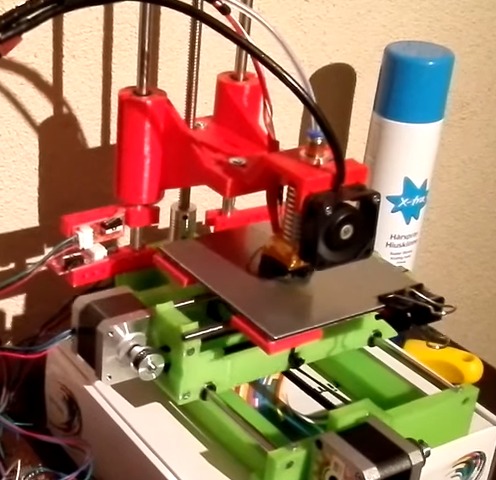
Cliff is in action again!!! Swedish 3d printing guru designed a new small RepRap and he wants YOU to help him name it! Live him a comment under a video with your idea. The no-name RepRap is a interesting looking machine that has many 3d printed structure parts that can be produced on a standard sized printbed.
Tetrix is a new 3d printer design based on needs of schools to provide simple and affordable teaching tool.
Here is the project description:
The TETRIX 3D-Printer was designed as an educational tool for middle and high school technology students, robotics teams, and adults. The purpose of constructing the printer is to train people's building, tool usage, electronics, CAD, and programming skills with a single project. You also get a 3D-printer once you're done!
The printer design is based on TETRIX parts, which are designed by PITSCO and used in the FIRST Tech Challenge robotics competition. The printer also utilizes elements of various RepRap printer designs, such as the Printrboard control system. The design is completely open-source, so feel free to personalize and alter your printer.
The overall cost of the printer is about $640, and the educational value is priceless! The majority of the cost is attributed to the TETRIX parts, but the high accuracy of the pre-drilled, pre-sized aircraft-grade aluminum saves time and reduces error, which outweighs the price.
Team of scientists hacked a Prusa I3 to develop new 3d printing process that uses laser to solidify ultrasound arranged resin fiber particle in a small vat. A laser diode module was mounted on the print head to cure the resin, with an emitting power of 50 mW. The laser diode was housed in a shroud, and was focused using a single 6 mm diameter lens, with a focal length of 20 mm. The small vat sized at 35mmx35mm was filled with low viscosity photocurable resin (Spot-A LV) and commercially sourced glass microfibres (Lanxess MF7904, length 50 μm, 14 μm). Ultrasonic transducer gives resin floating fiber the shape and laser solidifies it. It is a new form of stereolithography which could see some upscaling into more capable machines.
Detailed article and scientific paper "3D printed components with ultrasonically arranged microscale structure" can be found at:
Andreas Bastian developed this very interesting 3d printer with continuous build belt platform. Since it is a movable belt you could, in theory, print continuous or infinitely big objects. Yes, it is a DIY project and it is in development so the builds are rough but the concept is innovative. The name "Lum" is a version of the word "loom" as the developer is known for his work in textile-like 3d printed structures.
Here is Lum printing its own print bed! First part of a print platform belt is made on different 3d printer and then finished on Lum.
SprintRay presented their MoonRay high resolution UV DLP 3D printer. It will be priced at 3499 USD.
Key features:
Custom-built projector for 3D printing fine details: MoonRay’s resin requires UV light for proper curing. Other similar 3D printers use commercial projectors, which produce visible light but not pure UV light. The advantages of the custom UV LED projector in MoonRay are in the resolution and curing process. The MoonRay’s UV projector, RayOne, was custom designed with some special qualities:
Perfect light spectrum: The resin used for 3D printing cures under light with a 405nm wavelength. The custom-built projector hits the proper wavelength consistently across the build platform, which allows you to get real 100-micron resolution.
Runs cool and quiet: Utilizing a UV projector allows the MoonRay to avoid any overheating and makes it much quieter than other 3D printers.
Long lifespan: RayOne’s 50,000-hour lifespan means you won’t ever need to replace the bulb.
Revolutionary resin tank: the team designed the MoonRay’s resin tank to last, so there’s no more replacing your printer’s resin tank or changing the PDMS layer
MoonRay presentation:
Here is MoonRay on CES 2016 with more detailed presentation:
... it makes very fine objects like this 3d printed cloth:
David has developed his own 3d printer with almost all parts that are custom made including electronics and software. Kudos David!
It is wrapped into a nice bubble enclosure:
Short project description:
David tells us how he designed his rPrint 3D printer, the printer for pirates! A university project he has been working on for the last 9 months. Everything is custom, including the world's lightest weight direct drive extruder head, Sarrus linkage build plate, linear rail guides, and his awesome bubble enclosure. Not to mention his own custom controller, gcode interpreter, and highly optimised C++ string libraries.
Very detail video worth watching f you are deep into 3d printeting mechanics and electronics:
Lunavast CrafteHbot is strange looking attempt of a full color 3d printer from Japan. It uses inkjet attachment to paint on the deposited filament. Detailed information about it is limited and I'm skeptical that this is a robust solution. I'm not even sure if the inkjet attachment is custom made or used from a moded paper printer.
Tech specs:
3D printing method: Fused deposition manufacturing (FDM)
Color printing method:Direct to Object (Patent pending)
Build size ( X Y Z ): Single color output: 200 x 200 x 200 mm
Full color printing: 150 x 150 x 150 mm
Layer height: 0.1-0.3mm
Build materials: PLA/PETG/ABS etc.
Filament diameter: 1.75mm
Nozzle diameter: 0.4mm
3D print speed: 50-150mm/s
Extruder: Bondtech QR Double drive gear (Dual extruders)
Hot end: E3D V6
Electronics: RADDS + Arduino Due (32bit ARM Coretex M3)
Motor driver: RAPS128 128step microsteps
Firmware: aprinter
Inkjet printer: Required separately
Maximum inkjet ink spray distance: About 10mm
Inkjet ink: Lunavast 6 colors (CMYK/LC/LM)
Host software: Repetier-Host + Inkjet control plugin
Color model processing software: Blender
Operating system: Windows 7 (unknown if other are supported)
Weight: 30kg
Dimensions: 130 x 70 x 70 cm
Price: 2499 USD
Here is Lunavast 3d printing and coloring a map model:
3D Platform makes the 3DP1000 industrial strength large format 3D Printer which targets more professional and industrial markets. Key features are its large print volume, advanced mechatronics and possibility to produce objects with inserts.
Technical specifications:
Printer Size 1.42 x 1.67 x 1.52 m
Printer Weight: 300 lbs
Print Technology: FFF
Build Area: 1m x 1m x 0.5m (39″ x 39″ x 19″) – 1.5m diagonal
Layer Resolution: As low as 70 micron, (.0027″)
Material Compatibility: PLA, ABS, others
Filament Diameter: 3mm
Extruder Nozzle Diameter: 0.4mm
Print Bed: Heated borosilicate, 5mm thick
The Base printer is mounted on an industrial cart, and it's priced at $15,999, while the Base-Plus printer is mounted on an enclosed industrial cart, and it's priced at $16,699.
Here are some videos of 3DP1000:
... it also has some more advanced mechatronics:
Here is an overview of some of the printers abilities including large models with inserts:
Titan Robotics makes custom 3d printers as big as their customers want them. They have presented their mighty Atlas large format printer that can make some serious FDM objects. I'm looking forward to see their next generation machines.
Technical specifications:
FDM 3D Printer
Standard Model-30x30x45 inch build space (762mm x 762mm x 1143mm) -$19,500
Atlas 2.0-36x36x48 inch build space (915mm x 915mm x 1220mm) -$24,000
Moving table design
Precision machined steel frame
32 Bit Smoothieboard 4X or 5x with ReprapDiscount Graphic LCD -8GB SD Card
Simplify 3D (software settings included)
110V at 18amps or 220V Heated bed at 9 Amps
Prints most FDM style materials-ABS, PLA, PETG, Nylon, TPE Ninjaflex +many more
Driven by 16mm lead ground recirculating ball screws for virtually zero backlash
Size 15mm profiled linear rails and preloaded runner blocks
Stepper speed – Rapid travel up to 150mm/s
Servo speed – Rapid Travel up to 600mm/s (highly recommended)
IGUS Cableflex cables and cable guides rated for minimum 2,000,000 Cycles
Bulldog XL extruder capable of using 3mm filament.
Hexagon hot end with a .7mm nozzle. (swappable from .4mm-1mm)
350W or 450W Power supply
2 Days of Installation labor is included as well warranty on all items deemed defective from 1 Year date of purchase
Unlimited free customer phone service
Full documentation with user manuals and electrical schematics are included with the purchase of a machine
Each machine can be adapted and custom made according to the customer’s specifications.
Pricing
Standard Model:
$19,500 – 30x30x45 inch build space (762mm x 762mm x 1143mm)
$24,000 – 36x36x48 inch build space (915mm x 915mm x 1220mm)
Optional Additions:
+$300 – Additional 25.4mm of stroke on each axis
+$5,000 – Yaskawa Closed loop AC Servo option
+$1,000 – Dual extruder
+$11,500 – 14GA Sheet metal enclosure with embedded heating system and PID Controller for ABS Prints
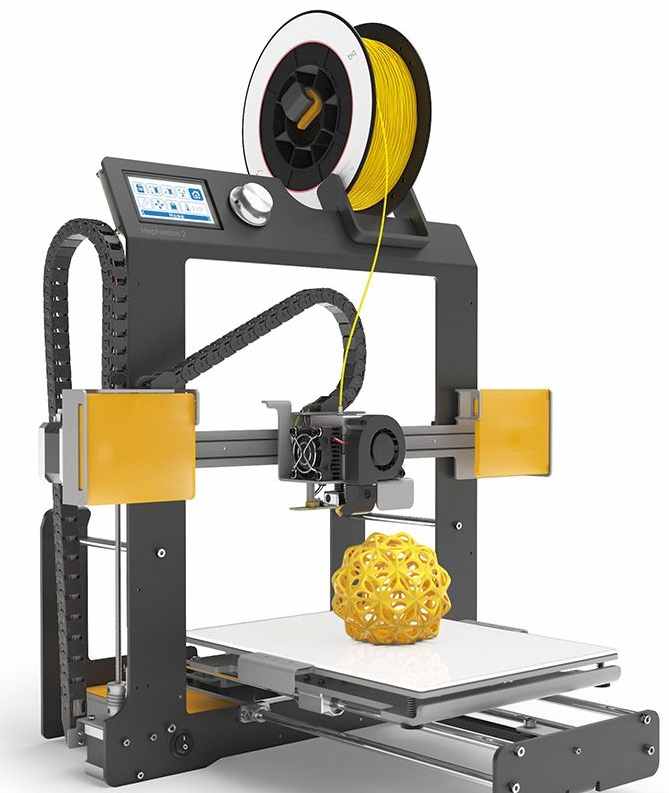
BQ is well known technology producer from Spain and they have launched their new Hephestos V2 3d printer. It has many powerful features but does not include heated print bed. Reviews show that it is ideal for PLA and elastic filaments due to extruder configuration.
Hephestos V2 Tech Specs:
PRINTING SPEED
Maximum: 200 mm/s* Subject to materials, profiles and software used.
RESOLUTION
Very high - 50 microns
High - 100 microns
Medium - 200 microns
Low - 300 microns
DIMENSIONS
Product without PLA reel:
(x)450 x (y)516 x (z)571 mm (static)
(x)450 x (y)605 x (z)571 mm (dynamic)
Product with PLA reel :
(x)450 x (y)516 x (z)661 mm (static)
(x)450 x (y)605 x (z)661 mm (dynamic)
Enclosure: (x)627 x (y)465 x (z)207 mm
Printable area: (x)210 x (y)297 x (z)220 mm
MATERIALS
Filament diameter: 1,75 mm
PLA, PLA-similar, FilaFlex and other elastomers
EXTRUDER MECHANICS
Own design extruder with double drive gear traction setting and filament guide to maintain compatibility with flexible or soft filaments.
0.4 mm nozzle for 1.75 mm filament
Finned dissipator with axial fan controlled by firmware (low noise)
Cooling blower
Sensor specifically designed for 3D printing (auto-levelling)
GENERAL MECHANICS
Powder-coated aluminium base and frame
Hard chromed bars for the Y axis
Lineal ball bearing for the Y axis
Recirculating ball bearing guides with flat runner for the X and Z axes
Cable chain
Flexible couplings for the screwed rods of the Z axis
3-point print bed levelling system with shock absorber
Rapid system for changing print bed
ELECTRONICS
Proprietary Mega 3D control unit
Inductive sensor for automatic calibration
LCD display with navigation knob
Power supply unit: 12V 100W
Thermistor 100k at the Hot-End
Cartrige heater: 12V 40W
SOFTWARE
Marlin-derived firmware
New features: auto-levelling, manual levelling using inductive sensor exclusively designed for 3D printing, power-saver system
Here is an excellent review by well known expert Richard Horne (aka. Richrap) where he also shows his excellent results with flexible filaments in various forms of elastomers.
Ultimaker released new and upgraded Ultimaker 2+ and Ultimaker 2 Extended+. There are several upgrades but nothing major changed in the technology.
Main upgrades are:
Geared feeder mechanism
Easy-swap nozzles with 0,25, 0,4, 0,6 and 0,8mm nozzles
Optimized air flow with new fancaps
Both models have the same prices as the previous models, with the Ultimaker2+ (build volume: 223 x 223 x 205 mm) priced at € 1.895,00 excl. VAT and the Ultimaker 2 Extended+ (build volume: 223 x 223 x 305mm) priced at € 2.495,00 excl. VAT.
Polaroid enters the 3d printing market with their ModelSmart 250S 3D printer. It also has a very costly proprietary print system but prints only PLA and PL variants.
Polaroid ModelSmart 250S 3D printer technical specifications:
Single extruder
Max model size 250(w) x 150(h) x 150(d) mm
Nozzle 0.4mm
Print speed 50mm/s (default) and can be set between 20mm/s and 100mm/s
The 250S’s print surface is not heated, so we asked how adhesion is accomplished. It turns out that you must apply a special double-sided adhesive sheet to the print bed - ON EVERY PRINT! In other words, every print requires a new sheet, even if the print fails. The price of the sheets was said to be USD$30 per 15 sheets, or about USD$2 per print!
This is an epic fail. Such a bad business model ... Guys, stop ripping your customers off ...
3D Systems released a new industrial metal laser sintering printer: the ProX DMP 320. What is the price? Well, if you have to ask, you probably can not afford it :-)
Mcor just presented their Arke printer and it is amazing! It is a small revolution in 3d printing industry since it brings low machine cost, low material cost, full color and speed on your desktop. It will be priced at 5999 Pounds range. It is a evolution of their industrial scale technology and competition has nothing comparable now.
Presentation videos:
Here is more detailed presentation of internal mechanics and quality of objects printed on the Arke:
Technical specifications:
Resolution: X, Y and Z axis: 0.1 mm (0.0039 in)
Colour: Photorealistic HD Colour 4800 x 2400 DPI in X, Y and 254 in Z (up to 508 in Z with 50GSM paper)
Build Size: 240 mm x 205 mm x 125 mm (9.5 in x 8 in x 4.9 in) Adaptive build volume
Build Material: Paper
Recyclable Parts/Material: Yes
Equipment Dimensions: 880 mm wide x 593 mm high x 633 mm deep (34.6 in wide x 23.3 in high x 24.9 in deep)
Power Requirements: 350W, 240v 50Hz or 120v 60Hz
File Formats for Printing: STL, OBJ, VRML, DAE, 3MF
Hardware Requirements: 8GB memory and 100GB hard drive, 1GB graphics card
Network Connectivity: Ethernet, USB, WiFi
Operating Systems: 64bit Windows 7, Windows 8, Windows 10 and OS X Yosemite
Regulatory Compliance: CE, UL
System Software: Mcor Orange
Office Compatibility: Yes
Key features:
Consistent, high-definition, photorealistic colour enables unique, innovative designs across a wide range of professional and consumer applications.
Print any colour, anytime on your 3D model, including text.
Only 3D printer with the ICC (International Colour Consortium) colour map for the most accurate what-you-see-is-what-you-get (WYSIWYG) colour in any 3D printer.
Low cost makes full-colour, professional-class 3D printing accessible
Low purchase price and running costs
Free Mcor Mobile App lets you get and share designs run and monitor your Mcor ARKe from your iOS or Android smartphone
Free Mcor Orange software for Mac and Windows-based PCs gives you complete control over your Mcor 3D printing projects, including loading, managing, customising and monitoring your 3D prints
Mcor ARKe is IoT ready
Provides full connectivity with options to connect via WiFi, Ethernet and USB
Safe and eco-friendly 3D process is ideal for on-demand printing right in your office or classroom
No harmful particle emissions, toxic chemicals or special facility requirements
Green process and recyclable materials
Adaptive Build minimizes the amount of material used
Professional-quality 3D printing is a must for every professional
Never-fail feed reliability, so you spend more time creating and less time fixing your 3D printer
High resolution: 0.1 mm (0.0039 in) in X, Y, Z
Build multiple models simultaneously
Easy-to-use, plug-and-play process
Hi-res touch screen with innovative LED progress task bar
RevoMaker uses hacked standard 3-axis FDM 3d printer and a laser cut cube core to print on its six sides. Cube core element can contain electronic components so ypu can make compex geometry objects with active components.
From project description:
We present “RevoMaker”, a self-contained 3D printer that creates direct out-of-the-printer functional prototypes, using less build material and with substantially less reliance on support structures.
By modifying a standard low-cost FDM printer with a revolving cuboidal platform and printing partitioned geometries around cuboidal facets, we achieve a multidirectional additive prototyping process to reduce the print and support material use. Our optimization framework considers various orientations and sizes for the cuboidal base.
The mechanical, electronic, and sensory components are preassembled on the flattened laser-cut facets and enclosed inside the cuboid when closed. We demonstrate RevoMaker directly printing a variety of customized and fully-functional product prototypes, such as computer mice and toys, thus illustrating the new affordances of 3D printing for functional product design.


 14.28.00